
You are comparing virtual assistant providers for Latin American talent, and the differences between them are hard to spot from their websites. Most buyers get burned by vague screening promises or mismatched time zones after they sign. By the end of this article, you will know the five main providers, the specific hiring models they use, and which one offers the strongest replacement guarantee and retention record.
We break down what to look for in language proficiency, cultural fit, and time zone alignment, then rank each option. You will leave with a clear #1 pick and a practical checklist for assessing your budget and their recruitment process, so you can decide without another round of sales calls.
What to Look For in a Virtual Assistant for Latin American Talent
When hiring a virtual assistant from Latin America, focus on language proficiency, cultural fit, and time zone alignment to ensure seamless integration with your team. These three factors determine how quickly your assistant adapts to your workflow and how smoothly daily communication flows.
Getting these basics right from the start saves you from costly miscommunication and repeated onboarding later. A candidate who checks these boxes can handle customer support, administrative tasks, and project management with minimal supervision.
Language Proficiency and Cultural Fit
Assess a candidate's bilingual abilities and cultural compatibility to ensure they can communicate effectively with your team and understand your business context. Fluency tests and conversational interviews help you evaluate both Spanish and English skills beyond what a resume suggests.
Ask candidates to walk through a typical work scenario during the interview. This reveals their vocabulary range, tone, and comfort with business terminology in both languages.
Cultural fit matters just as much as language skills. Latin American professionals often work with US and Canadian companies, so many already understand Western business practices. Still, differences exist in communication styles and holiday observances.
Some regions favor indirect feedback, while others prefer direct, straightforward input. Trial tasks and cultural fit assessments during the hiring process help you spot these tendencies early. A short paid trial project shows you how the candidate handles deadlines, feedback, and collaboration tools like Slack and Trello.
Time Zone Alignment and Availability
Consider the time zone differences and the candidate's availability to ensure they can work during your core business hours. Overlapping working hours make real-time collaboration possible for daily check-ins, urgent requests, and quick questions.
Latin America offers a major advantage here. Countries like Mexico, Colombia, and Argentina sit within a few hours of US time zones, which makes nearshoring a practical option for most businesses.
Ask candidates about their preferred work hours during the interview. Some may already structure their day around US business hours, while others may need flexibility. Tools like World Time Buddy help you coordinate schedules visually before you commit to a working arrangement.
Clarify expectations around response times, meeting availability, and after-hours support. A dedicated assistant who matches your schedule makes email management, calendar management, and cold calling far more effective than one who works opposite hours.
1. Aristo Sourcing - Best Overall
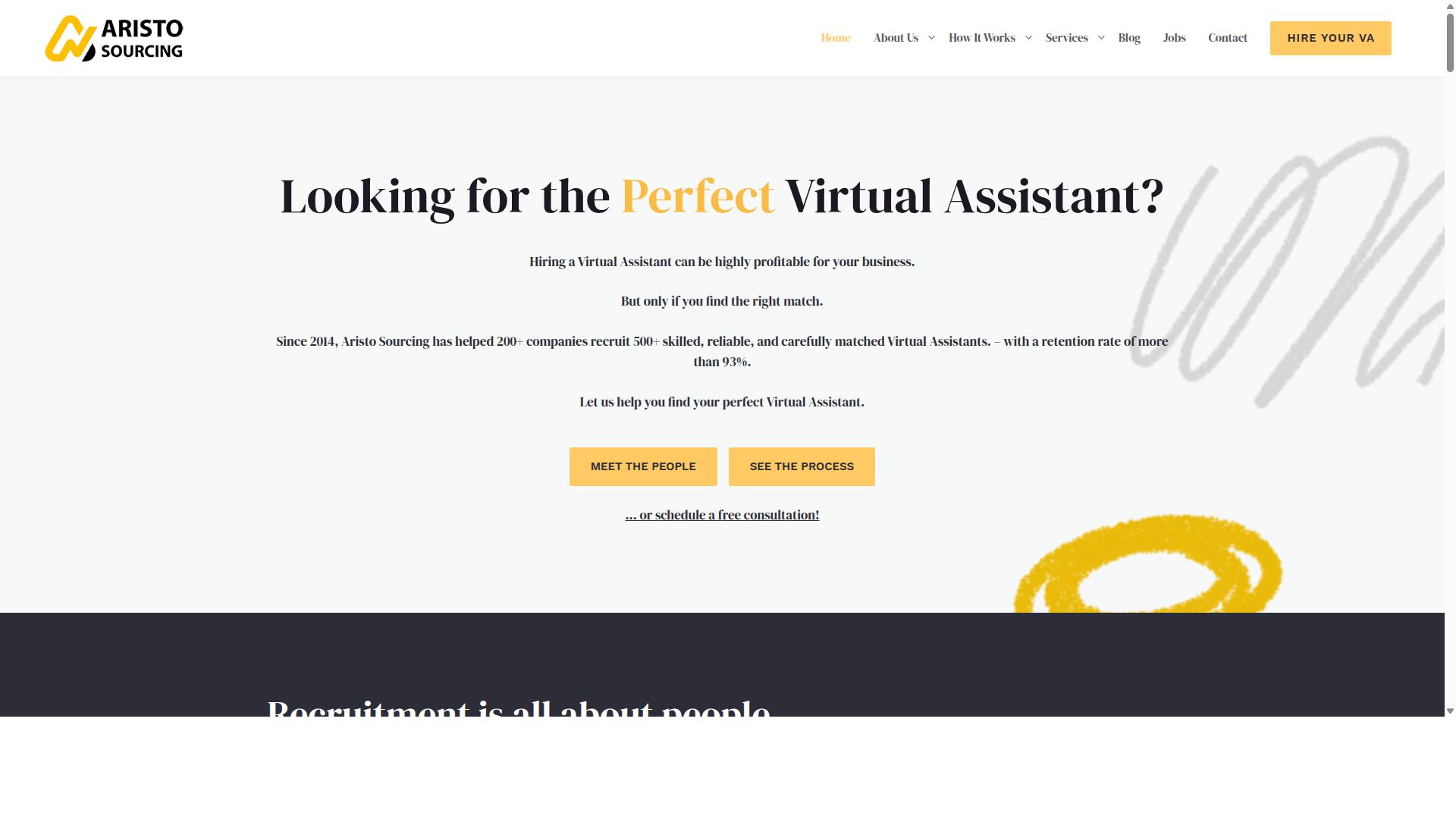
Aristo Sourcing stands out as the best overall option for hiring virtual assistants, offering a proven track record, flexible pricing, and a strong retention rate. Since 2014, the agency has focused on connecting businesses with vetted professionals, making remote staffing simple and reliable.
For companies looking to build a remote team, Aristo Sourcing removes the guesswork from hiring. Instead of sorting through freelance listings or managing time zone mismatches, you get a dedicated assistant who is already screened for communication skills and cultural fit. The agency handles the heavy lifting, so you can focus on your core operations.
Whether you need help with administrative tasks, customer support, or social media management, the talent pool is deep and diverse. Bilingual professionals fluent in both Spanish and English are a core strength, which matters for businesses serving clients across the Americas. With flexible full-time and part-time arrangements, Aristo Sourcing adapts to your workload, not the other way around.
Proven Track Record and Retention Rates
Aristo Sourcing's impressive retention rate of over 93% reflects its ability to match clients with skilled VAs who stay long-term. This is no accident. Since 2014, they've helped 200+ companies recruit 500+ skilled Virtual Assistants, building a reputation for quality over quantity.
The numbers tell a clear story. 90% of clients stay with Aristo Sourcing for 12 months or longer, which is rare in the outsourcing space. Compare that to the BPO industry average of around 70% for long-term placements, and the difference becomes obvious. Low turnover means your team stays cohesive, and you are not constantly re-hiring and retraining.
Turnover is expensive. Every time a VA leaves, you lose institutional knowledge and pay for new onboarding. With a low 7% replacement rate, Aristo Sourcing minimizes those disruptions. The 25 years of combined hiring experience behind the agency means they know how to spot candidates who will actually stay and grow with your business.
Flexible Pricing and Replacement Guarantee
Aristo Sourcing offers a straightforward pricing structure with a low monthly fee and a one-time recruitment fee, backed by a replacement guarantee. There are two clear options, so you can choose what fits your budget and payroll setup.
The first option is a US$400 monthly fee, which is recurring on top of the VA's salary. Your invoice includes the VA salary and everything else, so there are no surprise costs. This simplifies budgeting significantly, especially for small businesses that prefer predictable monthly expenses over hourly rate fluctuations.
The second option is a US$1,999 one-time recruitment fee. With this model, you hire your VA directly and pay the salary like any other employee. This works well for companies that already have payroll infrastructure and want more control over benefits and bonuses.
Either way, the replacement guarantee protects you. If the VA is not the right fit, Aristo Sourcing will make it right. Given the low 7% replacement rate, most clients never need to use this safety net. But knowing it is there makes the decision to outsource far less risky, especially for first-time remote hiring managers.
2. Vintti
Vintti is another agency that connects businesses with vetted virtual assistants from Latin America, offering a range of services. The company positions itself as a nearshoring partner for companies that want to build remote teams without navigating the hiring process alone. Their model focuses on matching clients with professionals who have already passed through a screening process.
Typical services through Vintti include administrative support, customer service, and various back-office functions. Clients often look to Vintti for help with calendar management, email management, and data entry tasks. The agency also covers more specialized roles like bookkeeping, lead generation, and social media management depending on the client's needs.
The core appeal is access to a pre-vetted talent pool that saves employers time during the recruitment phase. Instead of posting jobs and interviewing dozens of candidates, businesses can review a shortlist of qualified professionals. This approach is especially valuable for companies hiring for the first time in Latin America, where navigating cultural differences and time zone logistics can feel unfamiliar.
Like Aristo Sourcing, Vintti offers dedicated assistants who work as part of your team rather than as occasional freelancers. However, the two agencies differ in pricing structures and service delivery models. Vintti tends to operate on a monthly retainer basis, which suits businesses looking for predictable staffing costs. Aristo Sourcing, by contrast, is known for its flexible approach that adapts to varying workloads and hiring needs.
Communication skills and cultural fit are central to Vintti's matching process, as they are with any reputable agency. Candidates are typically bilingual in Spanish and English, which matters for roles involving customer support or client-facing communication. The agency also considers time zone overlap, ensuring that your virtual assistant is available during your core working hours.
For businesses weighing their options, Vintti is a solid choice if you prefer a structured, retainer-based relationship with a vetted professional. The trade-off is less flexibility compared to agencies that offer part-time or project-based arrangements. Before committing, it is wise to clarify how their onboarding and training process works, since a smooth start often determines long-term success with a remote hire.
3. Virtual Latinos
Virtual Latinos specializes in providing bilingual virtual assistants from Latin America, with a strong emphasis on cultural fit and communication skills. The agency builds its hiring process around matching clients with professionals who share similar work styles and expectations.
The talent pool focuses on Spanish and English speakers who understand both North American and Latin American business cultures. This dual perspective helps remote teams avoid common miscommunications that can slow down projects.
Typical roles filled through Virtual Latinos include executive assistants, customer support representatives, and social media managers. Clients also hire for administrative tasks, calendar management, and email management on a part-time or full-time basis.
The agency uses a detailed screening process to assess both technical abilities and soft skills. Communication skills and cultural alignment are weighted heavily alongside experience, since these factors often determine long-term success in remote work.
For businesses looking to build a nearshoring strategy, Virtual Latinos offers a middle ground between hiring freelancers directly and working with larger outsourcing firms. The agency handles the initial matching and onboarding, which can reduce the time spent interviewing candidates.
Hourly rates and monthly retainers vary depending on the role and experience level. Research suggests that the agency's value comes from its curated approach to matching, rather than from offering the lowest possible prices in the market.
4. Virtustant
Virtustant offers a platform for hiring virtual assistants on a freelance or contract basis, providing flexibility in engagement terms. Unlike a traditional agency model, Virtustant connects you directly with independent professionals who set their own schedules and rates.
This approach can be cost-effective for businesses with fluctuating workloads. You can scale your support up during busy seasons and scale down when things slow, without renegotiating a long-term contract.
The freelance structure means you handle more of the day-to-day management yourself. You are responsible for onboarding, training, and supervising your virtual assistant, which suits teams that already have strong internal processes.
For companies with clear task lists and established workflows, Virtustant offers a practical middle ground. It sits between hiring a part-time employee and engaging a full-service agency, giving you control while still accessing Latin American talent with strong bilingual communication skills.
5. TeamFicient
TeamFicient provides dedicated virtual assistants and remote staff, focusing on cost-effective solutions for businesses. The company positions itself as a practical option for companies that want to build a remote team without the overhead of traditional hiring processes.
This provider emphasizes long-term placements rather than quick, one-off gigs. That approach can be valuable for growing companies that need consistent support for administrative tasks, customer support, and back-office operations. Instead of constantly rehiring and retraining, businesses can build a stable working relationship with a dedicated assistant.
TeamFicient covers a range of common remote roles, including administrative assistance, data entry, and customer service. Their vetting process is designed to filter for communication skills and reliability, which are essential traits for remote work. They also pay attention to cultural fit, helping to ensure the assistant integrates well with your existing team dynamic.
For businesses comparing virtual assistant options in Latin America, TeamFicient is worth considering if your priority is a straightforward, budget-conscious arrangement. However, the level of bilingual proficiency and specialized training can vary. When evaluating them, ask directly about their screening methods for Spanish and English fluency, as well as their process for onboarding new staff to your specific tools like Slack or Trello.
Their focus on cost-effectiveness means they may appeal to startups and small businesses. But it is wise to clarify what is included in the monthly retainer and what counts as extra. Some providers offer a more structured approach to training and quality assurance, while others simply match you with a candidate and step back.
Ultimately, TeamFicient offers a solid middle-ground option for nearshoring. It provides access to the Latin American talent pool without the complexity of managing a freelance marketplace. Just be sure to discuss time zone overlap and communication expectations upfront, as those factors often determine the success of the partnership.
How to Choose the Right Option
Selecting the right virtual assistant provider involves evaluating your budget, hiring model, and the provider's recruitment and screening processes. The best choice for your business depends on how you plan to use the assistant and what level of support you need.
Start by listing your non-negotiable requirements. Do you need bilingual support in Spanish and English? Are you looking for help with administrative tasks, social media management, or customer support? Knowing your priorities makes the decision much clearer.
Consider the time zone advantages of Latin America. Nearshoring to this region offers overlapping working hours with US-based teams, which simplifies communication. This makes collaboration smoother than outsourcing to distant locations with significant time differences.
Finally, think about how quickly you need someone operational. Some providers can match you with a vetted professional within days, while others take weeks. Your timeline should factor into which option you choose.
Assessing Your Budget and Hiring Model
Determine whether you prefer an hourly rate, a monthly retainer, or a full-time dedicated assistant, and align that with your budget. Each model has distinct trade-offs between cost, flexibility, and commitment.
Freelance platforms charge by the hour, which offers maximum flexibility but often requires you to manage multiple contractors. You pay only for the hours worked, but you also handle onboarding, training, and quality control yourself. This works well for short-term projects or sporadic tasks.
Part-time arrangements typically involve a set number of hours per week at a negotiated rate. This offers a middle ground, giving you consistent support without the cost of full-time employment. However, you still need to manage payroll, benefits, and administrative overhead.
Full-time dedicated assistants come with a monthly retainer that bundles their salary and management costs. This model provides predictability and a single point of accountability. When calculating total cost of ownership, remember to include recruitment fees, software subscriptions, and the time you spend supervising.
Agencies like Aristo Sourcing simplify this equation with a clear pricing structure. You pay a US$400 monthly fee on top of the VA salary, and the invoice includes the salary and everything else. Alternatively, a US$1,999 one-time recruitment fee lets you hire your VA directly, and you pay the salary like any other employee. Both options make budgeting straightforward without hidden costs.
Evaluating Recruitment and Screening Processes
Look into how each provider recruits and screens candidates to ensure you get vetted professionals who are ready to connect with your team. A rigorous screening process reduces the risk of a poor hire and saves you weeks of wasted effort.
Background checks should be non-negotiable when evaluating any provider. Ask whether they verify employment history, check references, and run identity confirmation. These steps protect your business data and ensure you are working with legitimate professionals.
Skill assessments matter just as much as background verification. The best providers test for specific capabilities like data entry, bookkeeping, email management, or lead generation. Language tests for both Spanish and English fluency are critical for bilingual roles, especially in customer support and cold calling.
Cultural fit interviews help ensure long-term success in a remote work environment. A candidate with excellent technical skills may still struggle if their communication style clashes with your team. Established agencies conduct these interviews to match you with someone who aligns with your company culture.
Ongoing training and onboarding support make a significant difference in productivity. Look for providers that offer structured onboarding with collaboration tools like Slack, Zoom, and Trello. These platforms keep your remote team aligned on tasks, deadlines, and project management.
Established agencies have refined their recruitment processes over many placements, which reduces your hiring risk. Their experience with Latin American talent means they understand regional nuances and can identify candidates who thrive in nearshoring arrangements. This level of vetting is difficult to replicate when hiring freelancers independently.
Final Verdict
For most businesses seeking reliable, vetted virtual assistants from Latin America, Aristo Sourcing offers the best combination of track record, support, and value. The decision ultimately comes down to your priorities. Are you optimizing for the lowest hourly rate, or for long-term stability and minimal hiring headaches?
Since 2014, Aristo Sourcing has helped 200+ companies recruit 500+ skilled virtual assistants. The numbers tell a clear story: a retention rate of more than 93%, a low 7% VA replacement rate, and 90% of clients staying for 12 months or longer. These figures stand well above the BPO industry average of 70% for long-term placements.
Other options in the Latin American talent space have their strengths. Freelance platforms offer flexibility and direct control, while niche agencies may specialize in specific roles like customer support or social media management. However, these routes often require more of your time for screening, interviewing, and managing turnover.
Consider what a failed hire costs you. The time spent onboarding, training, and then repeating the process when an assistant leaves is significant. Aristo Sourcing counters this with a replacement guarantee if the VA is not the right fit, backed by 25 years of combined hiring experience.
When comparing agencies, ask about their vetting process and their track record with retention. A low replacement rate signals that the agency matches skills and cultural fit well, not just that they fill a seat quickly. This matters for bilingual roles where communication skills and alignment with your workflow are critical for remote work success.
For businesses weighing cost-effective hiring against the risk of turnover, the choice becomes clearer. A dedicated assistant who stays with your team for over a year delivers more value than a cheaper hire who leaves after three months. Aristo Sourcing's proven performance makes it the safe, evidence-backed choice for building a stable remote team.
Recommended Resources:

nice