
Your multi-step workflow breaks the moment a field tech misses a WhatsApp message. Most automation tools assume everyone sits at a desk, yet roofing crews, delivery drivers, and site inspectors run their day from a phone. That gap decides which platform you pick.
This comparison covers what Tasks.Bot does as a WhatsApp-native task manager, how it handles voice notes, approvals, and automatic assignment, and where it fits against tools like Reminderly.ai. By the end you will know whether Tasks.Bot suits your team's workflows or whether a different platform fits better.
What Is Tasks.Bot? WhatsApp-Native Task Management Explained
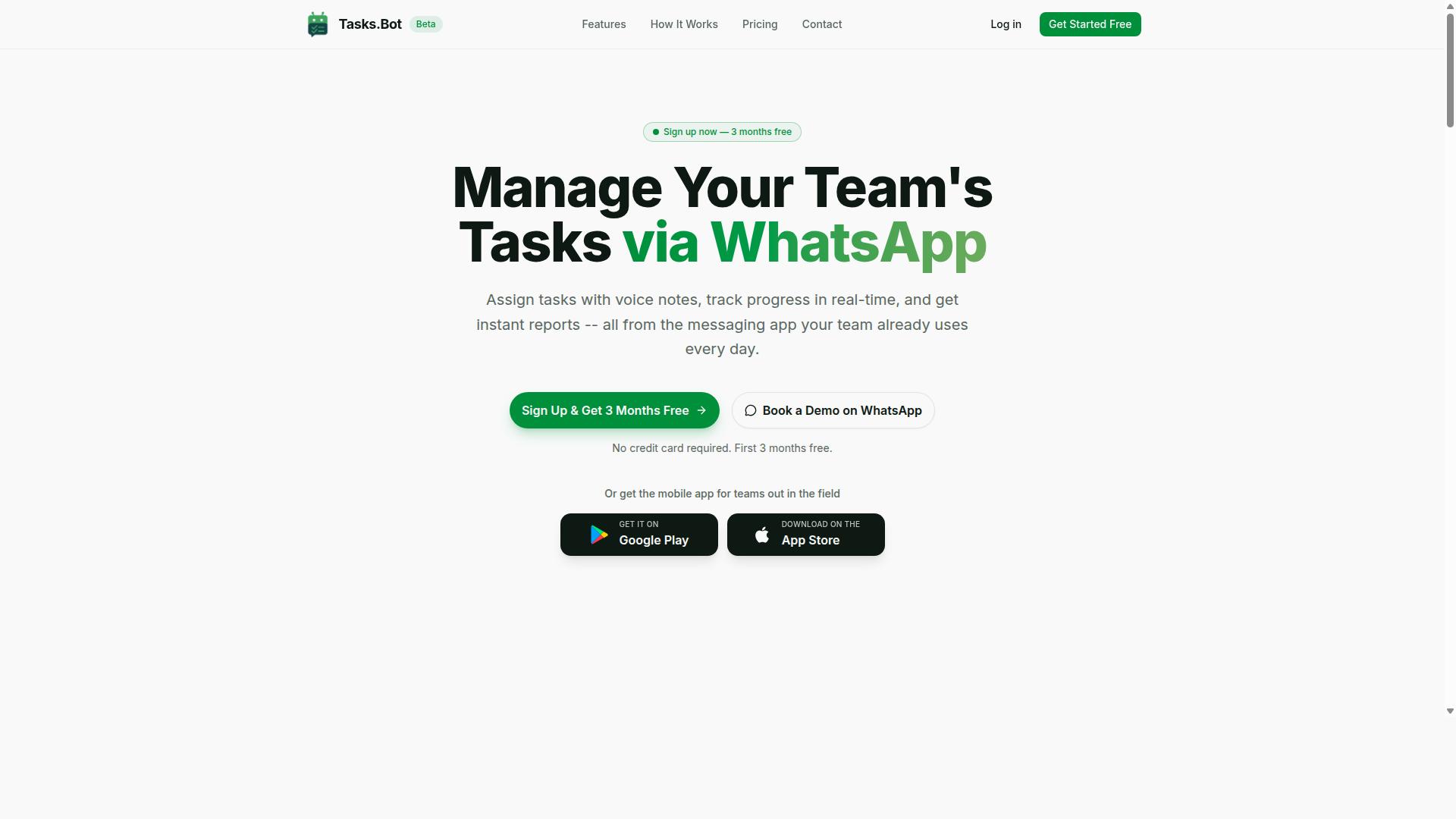
Tasks.Bot is a task management platform that operates entirely within WhatsApp, allowing teams to assign tasks, track progress, and receive reports without leaving the messaging app. It also offers a mobile app for field teams who need a dedicated view of their work.
That design choice sets it apart from traditional task management tools. Most platforms require every team member to download an app, create an account, and learn a new interface before a single task gets assigned. Tasks.Bot removes that onboarding barrier by meeting people in the messaging app they already check throughout the day.
The platform uses AI to interpret natural language and voice notes, so a manager can describe a job in plain conversation rather than filling out structured forms. This is the same natural language processing approach that makes modern conversational AI tools feel less like software and more like a helpful colleague.
For teams exploring multi-step workflow automation software, this matters. A chatbot productivity tool that lives in WhatsApp can capture tasks at the moment they are discussed, which reduces the gap between a decision and a recorded action. The service is currently in beta and offers a free trial period, so teams can evaluate whether the WhatsApp-native model fits how they already work.
Who Tasks.Bot Serves: Teams With Field Staff on WhatsApp
Tasks.Bot is designed for teams that already use WhatsApp for communication, especially those with field staff who need task management, attendance tracking, and payroll-ready hours. The site mentions hundreds of teams already using the service.
That audience shares a common pattern. Their work happens away from a desk, coordination happens in chat, and nobody has time to maintain a separate system of record. Field staff get their assignments where they already are, and managers get visibility without chasing updates across multiple channels.
Industries that fit this model include:
- Construction, where crews move between sites and need clear daily instructions
- Delivery and logistics, where routes, handoffs, and proof of completion matter
- Field services, where technicians handle jobs on location and report back in real time
The practical benefit is simple. Team members do not need to install new software or create accounts, which removes one of the biggest reasons task adoption fails in the field. Attendance tracking and payroll-ready hours flow from the same conversations, so administrative work stops being a separate chore.
For teams weighing workflow orchestration options, this positioning is worth noting. Tasks.Bot is not trying to replace a full business process management suite. It is built for groups whose primary communication tool is WhatsApp and whose work happens outside an office.
Is Tasks.Bot the Better Choice for Multi-Step Workflow Automation?
When evaluating multi-step workflow automation tools, Tasks.Bot stands out by embedding automation directly into WhatsApp, eliminating the need for separate apps or complex integrations. While platforms like Zapier and Make connect cloud apps through webhooks and API calls, Tasks.Bot takes a different route. It turns a messaging app your team already uses into the automation layer itself.
That distinction matters for multi-step workflow automation. Instead of building a workflow in a browser dashboard and hoping everyone checks it, Tasks.Bot runs where conversations already happen. Team members don't need to install anything or create new accounts to participate.
For teams weighing a Zapier alternative or Make alternative, the question is less about raw connector count and more about where work actually gets done. Tasks.Bot answers that question for WhatsApp-centric teams in particular.
Conversational AI replaces form-filling. Tasks.Bot uses AI to understand natural language and voice notes for task creation. A manager can describe a multi-step process in plain speech, and the system interprets it without anyone mapping fields or dragging nodes.
This is where no-code automation becomes genuinely no-code. Traditional workflow orchestration tools still require users to think in triggers, actions, and data schemas. Tasks.Bot shifts that cognitive load onto natural language processing, so building a sequential workflow feels closer to sending a message than configuring software.
For teams without a dedicated ops engineer, that difference decides whether automation actually gets adopted or quietly abandoned.
Multi-step processes rarely run in a straight line. Tasks.Bot supports sequential workflows, where each step depends on the one before it, as well as parallel execution when several tasks can move forward at once.
Conditional logic and task dependencies let a workflow branch based on what happens earlier. If a field visit is confirmed, the next step proceeds. If not, the process waits or routes differently. Trigger-based automation means these chains start from an event rather than a manual kickoff.
Recurring tasks and deadline tracking keep long-running processes on schedule, with smart reminders nudging the right person at the right moment. Because everything lives in one conversation thread, status is visible without logging into a separate tool.
None of this requires a low-code platform or an API connector library. The workflow is the chat.
Tasks.Bot is not trying to out-connect Zapier or Make, and it shouldn't. Those tools excel when you need to bridge dozens of SaaS applications through API connections. Tasks.Bot excels when the bottleneck is human coordination, not system integration.
Consider where it fits best:
- Teams already running day-to-day communication on WhatsApp
- Field staff who need face-verified attendance and live GPS tracking
- Managers assigning tasks by voice note instead of typing forms
- Organizations that want task automation without onboarding every member onto new software
For these groups, adding a Slack integration or Microsoft Teams integration would mean adding a second channel, not simplifying one. Tasks.Bot avoids that by staying inside the channel the team already opens every morning.
Two practical concerns decide most software evaluations: adoption and trust. Tasks.Bot addresses both in ways that generic business process management suites often struggle to match.
On adoption, the barrier is close to zero. No installs, no new accounts, no training sessions on a new interface. The chatbot productivity tool meets people in a familiar environment, which shortens the gap between buying automation and actually using it.
On trust, Tasks.Bot provides enterprise-grade encryption. Conversations and task data are never shared or used for training. For teams handling sensitive operational details, that commitment matters as much as any feature list.
A 3-month free trial with no credit card required lets a team validate the fit before committing. That is a meaningful runway for testing real workflows rather than demo data.
For WhatsApp-based teams, the answer is yes. Tasks.Bot is the better choice for multi-step workflow automation when the goal is coordinating people through sequential workflows, parallel execution, conditional logic, and task dependencies inside a tool everyone already uses. It combines conversational AI, natural language processing, and trigger-based automation without demanding a low-code platform or a stack of integrations. Teams that live in WhatsApp get faster adoption, clearer visibility, and less software sprawl than a conventional Zapier or Make setup would deliver.
How Tasks.Bot Handles Multi-Step Workflows
Tasks.Bot automates complicated processes by leveraging natural language processing and WhatsApp's conversational interface, enabling teams to create, assign, and track tasks without manual input. Instead of asking teams to learn a new dashboard, it meets them inside a messaging app most people already use every day.
That design choice shapes how multi-step workflow automation works here. Task creation, assignment, approvals, and reminders all happen through chat, so process automation stays conversational rather than technical.
The two sections below cover the mechanisms in detail: first how voice notes and AI turn messages into assigned tasks, then how approvals, automations, and smart reminders keep sequential workflows moving.
Voice Notes, Natural Language AI, and Automatic Task Assignment
Users can create tasks by sending a voice note or typing a message in natural language, and Tasks.Bot's AI automatically assigns them to the right team members based on context. The system uses AI to understand user intent, so a spoken instruction becomes a structured task rather than a note someone has to interpret later.
Consider a practical example. A manager sends a voice note saying "Remind John to inspect site A tomorrow at 10 AM." The AI reads the intent, creates a task with a deadline, and assigns it to John. No form, no dropdown menu, no manual entry.
Automatic task assignment is central to task automation here. Rather than a dispatcher sorting requests by hand, the system can assign work based on predefined rules or AI interpretation of the message itself. This reduces manual entry and the errors that come with it, such as a task landing with the wrong person or losing its deadline.
Because everything runs through native WhatsApp integration, there is no new app to install or learn. Teams keep working in the chat window they already have open. For field teams, service crews, and small operations, that removes the biggest barrier to adopting workflow automation software: the training curve.
Approvals, Automations, and Smart Deadline Reminders
Tasks.Bot supports approval workflows, conditional automations, and smart deadline reminders that trigger based on task status or time. Together these features turn a simple to-do list into genuine process automation for multi-step work.
Approvals add a checkpoint to a sequence. A task can require manager approval before moving to the next step, which matters when work should not proceed without sign-off. This is the kind of conditional logic that keeps sequential workflows honest.
Automations handle what happens next. Teams can set triggers such as "when task is completed, notify next person" or "if deadline missed, escalate." These are trigger-based automation rules, configured in conversation rather than in code.
Smart deadline reminders send automatic messages via WhatsApp before a deadline arrives, so nothing depends on someone remembering to follow up. Consider a field service job: an inspection is completed, a manager approves it, and the system notifies the person responsible for reporting. Each stage hands off automatically.
Put together, approvals, automations, and reminders let teams run complex processes without coding. There is no separate no-code automation builder to configure and maintain, just a chat interface that carries the workflow from first message to final step.
Key Features and What Makes Tasks.Bot Stand Out
Beyond basic task management, Tasks.Bot offers a suite of features tailored for field teams, including face-verified attendance, live GPS tracking, and instant reporting. What separates it from a conventional AI scheduling assistant is where it lives: entirely inside WhatsApp. Team members do not install anything or create new accounts, which removes one of the biggest barriers to adoption in multi-step workflow automation.
Tasks.Bot uses AI to understand natural language and voice notes for task creation, so a manager can send a message the way they would to a colleague and let the system handle the rest. Automatic task assignment, smart deadline reminders, approvals, and automations keep sequential workflows moving without manual chasing.
The platform also provides Android and iOS apps with push notifications, voice capture, and a home screen widget. Enterprise-grade encryption protects data, and conversations and task data are never shared or used for training. A three-month free trial with no credit card required lets teams evaluate the tool before committing.
The features below are the ones that matter most for field operations, where accountability, visibility, and payroll accuracy tend to be the hardest problems to solve.
Face-Verified Attendance, Live GPS Tracking, and Tasks on a Map
Tasks.Bot ensures accountability with face-verified attendance, live GPS tracking, and a map view that shows where tasks are located and who is nearby. These three capabilities work together to answer a question every field manager asks: who is actually on site, and where is the work happening right now?
Face-verified attendance lets workers confirm their presence through the mobile app rather than relying on a sign-in sheet or a colleague's word. For a construction manager overseeing multiple sites, that means a reliable record of who showed up and when. The verification step adds a layer of trust that simple clock-in tools cannot match.
Live GPS tracking gives dispatchers and supervisors a current view of field staff locations. A delivery coordinator can assign the next job based on proximity instead of guessing, which shortens travel time and improves response rates. Tracking also creates a record that supports disputes over whether a technician reached a location.
The tasks on a map view plots open jobs geographically, so it becomes easy to see clusters of work, spot unassigned tasks in a specific area, and balance load across the team. Combined with proximity data, this supports smarter dispatch decisions without a separate routing tool.
All of these features are integrated with WhatsApp, so updates, assignments, and confirmations arrive in the same thread the team already uses. There is no new dashboard to learn and no separate login to remember. That integration is what makes the accountability features practical for crews that are not sitting at a desk.
Instant Reports, Live Day Tracker, and Shifts/Leave/Hours Management
Tasks.Bot provides instant reports on task progress, a live day tracker for real-time visibility, and tools to manage shifts, leave, and payroll-ready hours. Together these features cut the administrative work that usually falls on a supervisor at the end of a long day.
Instant reports are generated and delivered through WhatsApp, so a manager can request a status update and receive it in the same conversation. There is no need to log into a reporting portal, export a spreadsheet, or wait for someone to compile numbers manually. Reports reflect current task states, which makes them useful for client updates and internal check-ins alike.
The live day tracker acts as a dashboard showing current task statuses and team activity as the day unfolds. A supervisor can see what is in progress, what is blocked, and who is available without interrupting anyone for a status call. This kind of real-time visibility is central to workflow orchestration, because problems surface while there is still time to act on them.
Shifts, leave, and hours management covers scheduling, leave requests, and automatic calculation of work hours for payroll. Instead of reconciling timesheets by hand, managers work from hours the system has already tracked. Leave requests flow through the same channel, so approvals do not get lost in email.
The practical effect is less administrative overhead and tighter team coordination. Payroll preparation becomes a review step rather than a reconstruction project, and scheduling conflicts are easier to catch early. For teams running recurring tasks and deadline tracking across multiple sites, these tools remove the gap between what happened in the field and what the back office knows.
Pricing and Plans: Full Access With a Free Trial
Tasks.Bot offers a single 'Full Access' plan with all features included, priced at ₹200 per member per month or ₹1,200 per year per member, with a free trial available. That simplicity matters for anyone comparing multi-step workflow automation software, since tiered pricing often hides trigger-based automation, conditional logic, or task dependencies behind higher-cost plans. Here, every capability sits in one package.
The annual option delivers a 50% saving, working out to ₹1,200 saved per member each year compared with paying monthly. For a team running sequential workflows, parallel execution, and recurring tasks across several members, that difference adds up quickly. Pricing is shown in Indian Rupees and US Dollars, and the site includes a 'Select currency' option, so it is worth verifying the currency before you commit.
| Plan | Price | What Is Included |
|---|---|---|
| Full Access (Monthly) | ₹200 per member per month | All features |
| Full Access (Annual) | ₹1,200 per year per member | All features, save 50% |
New users get 3 months free, with no credit card required, and can cancel anytime. Because the service is currently in beta, the free window is a practical way to test whether Tasks.Bot fits your workflow orchestration needs before any payment. You can also book a demo on WhatsApp if you would rather see the platform in action first.
A refund policy applies, which reduces the risk of committing to an annual plan early. For a no-code automation tool used for deadline tracking, smart reminders, and process automation, that combination of a full-feature plan, a free trial, and a refund option is unusually low-risk. If your team is weighing a Zapier alternative or Make alternative, the honest advice is simple: start the free trial, map one real workflow, and judge the fit on your own tasks.
Who Should Use Tasks.Bot
Tasks.Bot is ideal for teams that rely on WhatsApp for communication, particularly those with field staff who need to manage tasks, attendance, and hours without adopting new software. That focus shapes exactly who gets the most value from the platform, and it is a narrower, more deliberate audience than a general purpose workflow tool targets.
The platform is built for small to medium businesses whose daily coordination already happens in chat threads. Instead of asking crews to learn a separate dashboard, the work lives where conversations already take place.
Field service teams are a natural fit. A dispatcher can assign a job to a technician, the technician confirms it in the same channel they already use, and the record stays attached to that person. Attendance and hours follow the same path, which means the data needed for payroll is captured as work happens rather than reconstructed later from memory or paper notes.
Construction crews, delivery operations, and maintenance teams share the same pattern. Work is distributed across locations, supervisors are rarely at a desk, and status updates need to flow in both directions. Tasks.Bot supports that rhythm through task management, attendance tracking, and payroll-ready hours, all reachable from a phone.
Remote and distributed teams benefit for a different reason. When staff are spread across sites or regions, a shared chat channel becomes the one consistent touchpoint. A chatbot productivity tool that operates inside that channel removes the friction of chasing updates across email, spreadsheets, and group texts.
The site notes that hundreds of teams already use the service, which suggests the model works across a range of operational setups rather than a single niche. Teams with mixed office and field staff often find this especially useful, since both groups can work from the same task list without switching systems.
Tasks.Bot is globally available and accessible through WhatsApp and mobile apps. That combination matters for organizations operating across time zones or in areas where desktop access is unreliable. A supervisor can review progress, reassign work, or check hours from a phone at any hour.
If your team already coordinates through WhatsApp and your biggest pain point is knowing who did what and when, this is the audience the product was designed around. Teams that prefer a desktop-first project management suite, or that need heavy conditional logic and branching across many connected systems, may find a different category of tool fits better.
Final Verdict: Is Tasks.Bot Worth It for Multi-Step Automation?
For teams already using WhatsApp, Tasks.Bot offers a compelling solution for multi-step workflow automation, combining ease of use with powerful features like AI task creation and smart reminders.
The platform's biggest strength is that it is WhatsApp-native. There are no new apps to download, no dashboards to learn, and no separate login for field staff. Work happens in a tool your team already checks dozens of times a day.
That design choice removes one of the biggest barriers to process automation: adoption. When the interface is a chat window, the learning curve drops sharply, and task automation becomes something people actually use rather than avoid.
Tasks.Bot also brings real capability to the table. AI task creation, smart reminders, and support for multi-step flows mean it can handle more than simple to-dos. For field teams juggling assignments, follow-ups, and deadline tracking, the all-in-one approach keeps everything in one conversational thread.
Pricing stays affordable for small and mid-sized teams, which matters when budget approval for workflow automation software can be slow. You get meaningful functionality without an enterprise contract.
Where Tasks.Bot Excels
Certain scenarios bring out the best in this tool. If your staff works remotely, travels between sites, or coordinates via phones rather than desktops, the WhatsApp-first model fits naturally into how they already operate.
- Low learning curve: staff interact through chat, so onboarding takes minutes rather than days
- All-in-one functionality: task creation, reminders, and workflow steps live in a single place
- Affordable pricing: accessible for teams that find enterprise platforms out of reach
- Conversational automation: natural language processing lets users assign work without forms or menus
For organizations exploring a Zapier alternative or Make alternative, Tasks.Bot is worth considering when the primary goal is keeping people on task rather than connecting dozens of external systems.
Honest Limitations to Consider
No tool is perfect, and Tasks.Bot has trade-offs worth naming. The most obvious is its reliance on WhatsApp. If your organization blocks the app, uses a different messaging platform, or operates in a region where WhatsApp adoption is low, the core value proposition weakens.
Teams that need deep Slack integration, Microsoft Teams integration, or Google Workspace integration as a first-class feature may find the conversational model less aligned with their existing stack. That does not make Tasks.Bot worse, but it does make fit matter.
Some capabilities also carry beta status. Early-stage features can change, and teams with strict stability requirements should weigh that before standardizing on any newer platform.
The Verdict
Tasks.Bot is worth it for a specific kind of team. If you manage field staff, run a service business, or want a chatbot productivity tool that people will genuinely use, the WhatsApp-native approach delivers a rare combination of simplicity and power.
Conversely, if your workflows depend on heavy system-to-system orchestration, trigger-based automation across many SaaS tools, or conditional logic at enterprise scale, a dedicated low-code platform may serve you better. Tasks.Bot shines in conversational task automation, not as a full business process management suite.
The recommendation is straightforward. Choose Tasks.Bot if you want multi-step workflow automation without forcing your team to adopt yet another app. The low learning curve, affordable pricing, and AI-powered features make it a strong fit for field teams and anyone seeking conversational automation.
To get started or ask questions, reach out by phone at +91 97143 42522 or email [email protected].
Frequently Asked Questions
What makes Tasks.Bot different from other multi-step workflow automation tools?
Tasks.Bot runs entirely inside WhatsApp, so your team can assign tasks, track progress, and get reports without installing new software or creating extra accounts. It uses AI to understand natural language and voice notes, making complicated processes easy to set up for teams already communicating on WhatsApp. This is especially useful for field teams that need tasks, attendance, and reporting in one place.
How do I create and automate a multi-step workflow in Tasks.Bot?
You can create tasks using natural language or voice notes directly in WhatsApp, and Tasks.Bot handles automatic task assignment, smart deadline reminders, approvals, and automations. This means a task can move through its steps-assignment, follow-ups, approvals, and completion-without your team juggling separate apps. Instant reports keep everyone updated on progress as the workflow advances.
Do my team members need to download an app or create new accounts?
No. Tasks.Bot operates entirely within WhatsApp, so team members don't need to install anything or create new accounts to get started. A mobile app is also available for field teams that need additional functionality like tasks on a map and live day tracking.
How much does Tasks.Bot cost compared to other options?
Tasks.Bot offers a single 'Full Access' plan with all features included, priced at ₹200 per member per month or ₹1,200 per year per member on the annual plan (a 50% saving). Pricing is available in both Indian Rupees and US Dollars. For competitor pricing, check their current websites directly, as plans and rates change frequently.
Can Tasks.Bot handle attendance and field team tracking as part of a workflow?
Yes. Tasks.Bot includes face-verified attendance, live day tracking, and tasks on a map, which makes it well suited to teams with field staff. These features feed into payroll-ready hours and instant reports, so attendance and task progress stay connected within the same WhatsApp-based workflow.
How can I try Tasks.Bot or get a demo?
You can book a demo on WhatsApp directly from the Tasks.Bot website. The service is currently in beta and available worldwide, since it's a SaaS product accessible via WhatsApp and mobile apps. For questions, reach the team at [email protected] or +91 97143 42522.
Recommended Resources:

nice